
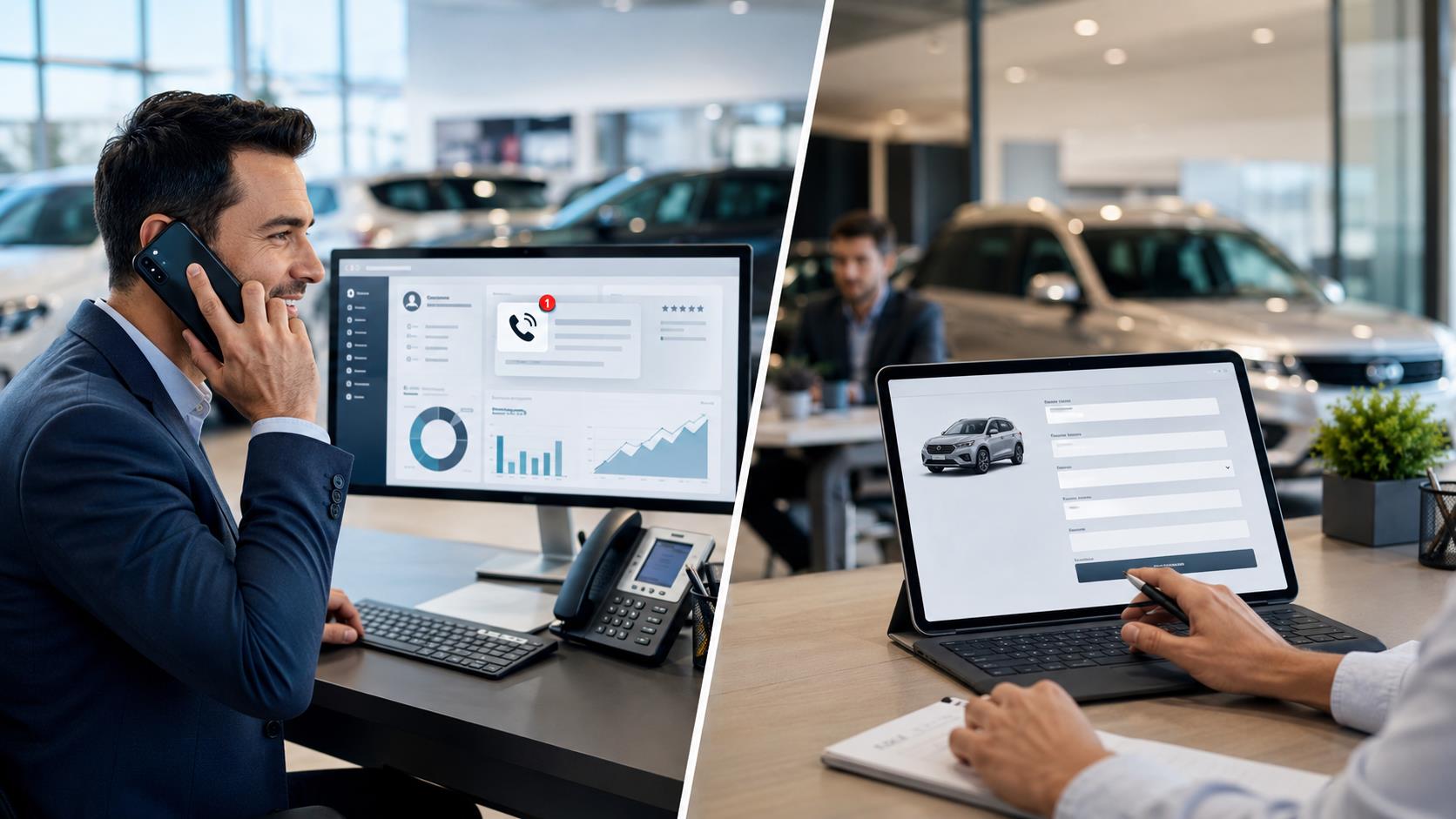
TL;DR — Quick Summary
- Inbound phone leads convert at a higher rate per contact than form fills because the buyer is already on the line, motivated, and ready to talk financing.
- Form fills win on volume and cost per lead — they fill the top of the funnel cheaply, but conversion depends entirely on how fast your team follows up.
- Speed-to-lead is the deciding factor: dealerships that respond within 5 minutes are roughly 9× more likely to connect than those who wait 30 minutes.
- The strongest dealership strategy uses both — high-volume form fills backed by AI-powered SMS follow-up, plus live transfers that arrive pre-warmed.
- Autocarleads delivers exclusive, pre-screened leads in both formats so your team is the only one calling, every time.
Ask ten dealer principals which lead type they trust and you’ll get a near-even split. The inbound calls vs form fills debate has run for years in Canadian auto finance because both have a real claim to the title. An inbound call puts a live, motivated buyer in front of your team in seconds. A form fill costs less, scales faster, and can flood your BDC with volume overnight.
The honest answer is that one format converts higher per contact while the other wins on economics — and which matters more depends on your follow-up speed and your sales process. This guide breaks down the real numbers behind each, where each one falls apart, and how the highest-performing dealerships stop choosing and start using both.
AUTOCARLEADS
Not sure which lead type fits your sales floor?
We’ll walk you through how our exclusive calls and form leads perform for dealerships your size — no pitch, just numbers. Had a slow month? Let’s change that.
Inbound Calls vs Form Fills: The Short Answer
Per individual contact, inbound calls convert higher than form fills — often two to three times higher — because the buyer has already self-selected as ready to talk. Form fills convert at a lower rate per lead but cost far less and arrive in much greater volume, which can produce more total deals if your follow-up is fast.
Think of it as quality versus quantity, but with a catch: a form fill that sits in your CRM for an hour is worth almost nothing, while an inbound call that goes to voicemail is a lost deal in real time. The format sets the ceiling; your process determines whether you reach it.
For Canadian dealerships weighing the two, the practical question isn’t which is “better” in the abstract — it’s which mix matches your BDC capacity, your average gross, and how quickly your team actually picks up the phone. The answer almost always involves how live transfers improve dealership close rates alongside a steady flow of web leads.
Why Inbound Phone Leads Close at Higher Rates
Inbound calls close at higher rates because intent and timing are already aligned. The buyer picked up the phone — or accepted a live transfer — at the exact moment they wanted to discuss financing, so there’s no gap between interest and conversation for a competitor to fill.
A live voice also lets your F&I team qualify and build rapport in one motion. They can hear hesitation, answer objections, and gauge credit comfort without waiting on a callback. That immediacy is why a phone lead frequently converts at two to three times the rate of an unworked web form, even when both came from the same campaign.
“Dealerships that follow up within 5 minutes of a lead submission are 9× more likely to connect with the buyer than those who wait 30 minutes.” — MIT Lead Response Management Study
The trade-off is supply. You can’t manufacture inbound calls on demand the way you can scale form submissions, which is why phone leads carry a higher cost per lead. When those calls are exclusive, though, the math holds up — your team is the only one calling, so you keep the difference between subprime and prime leads working in your favour instead of racing three other stores to the buyer.
Where Form Fills Still Win
Form fills win on three things: cost, volume, and scalability. A web form lead typically costs a fraction of a phone lead, arrives in far greater numbers, and lets a dealership build a pipeline it can work on its own schedule rather than waiting for the phone to ring.
For a BDC team processing 60 to 100 leads a month, form fills are the engine that keeps the pipeline full between phone leads. They also create a record — name, vehicle interest, completed application — that your team can reference, re-market to, and nurture over weeks rather than minutes.
The catch is that a form fill is only worth what your follow-up makes it. The lead has the lowest conversion rate of any format the moment it goes cold, which is why how pre-screening and income verification work matters so much. A pre-qualified web lead with verified income converts dramatically better than a raw form that anyone with a credit card could have submitted.
AUTOCARLEADS
Canadian dealerships close 6–15% of the leads we deliver.
Every Autocarleads lead — call or form — is 100% exclusive, pre-screened for a minimum $1,800/month income, and backed by AI-powered SMS follow-up within 5 minutes. We geo-target to your territory so you’re never sharing buyers with the dealer down the road.
The Real Variable: Speed-to-Lead
Speed-to-lead changes the entire inbound calls vs form fills comparison, because it determines whether a form fill performs like a phone lead or like dead weight. The industry-standard response window is under 5 minutes — past that, connection rates fall off a cliff.
A form fill answered in two minutes behaves almost like an inbound call: the buyer still remembers submitting, still wants the car, and is still comparing options. The same lead answered three hours later is competing against every other dealer the buyer contacted in the meantime — and against the buyer simply losing interest.
⚠️ Speed-to-Lead Warning: The conversion advantage of any lead — call or form — decays by the minute. A web form left untouched for 30 minutes can lose most of its closing potential before your BDC ever dials it. If your follow-up isn’t automated, you’re paying for leads you can’t convert.
This is the gap automated follow-up closes. When an AI-powered SMS reaches the buyer within five minutes of submission, the form fill stays warm until a human can take over — which is exactly how high-volume web leads start converting at rates closer to phone leads. Understanding how speed-to-lead determines deal outcomes is what separates a dealer who buys leads from one who closes them.
How to Get the Best of Both Lead Types

The top-performing dealerships don’t pick one format — they run both with a clear role for each. Form fills feed the pipeline at scale; inbound calls and live transfers convert the highest-intent buyers on the spot. The mix gives you reach and close rate at the same time.
A practical blueprint for a Canadian dealership looks like this:
- Use form fills for volume and reach — keep a steady inflow so your BDC always has buyers to work.
- Automate the first touch — AI SMS within 5 minutes keeps every web lead warm until a rep is free.
- Reserve your best closers for live calls — route inbound and transferred buyers straight to F&I.
- Insist on exclusivity — shared leads put you in a footrace; exclusive ones let process win.
- Track conversion by source — measure each format separately so budget follows what closes.
Credit-challenged buyers especially benefit from this dual approach, since they often need reassurance a form can’t provide. Pairing volume web leads with a live conversation is the same principle behind why exclusive subprime leads close at higher rates — the buyer feels guided instead of processed.
What This Means for Your Dealership’s Lead Strategy
Stop framing inbound calls vs form fills as an either/or decision. Phone leads give you a higher close rate per contact; form fills give you affordable scale — and with fast, automated follow-up, the conversion gap between them narrows significantly. The right answer is a blend tuned to your team’s capacity.
If your BDC is small and your closers are strong, lean toward live calls and transfers. If you have the staff to work volume and the systems to respond fast, load up on form fills and let automation protect the speed-to-lead window. Most dealerships across Canada land somewhere in between, and the ratio should shift as your conversion data comes in.
What doesn’t change is the requirement underneath both formats: the leads have to be real, exclusive, and verified. Autocarleads has processed more than 180,000 applications for 150+ Canadian dealerships precisely because both our calls and our form leads are pre-screened before they ever reach your floor — so whichever format you favour, you’re working buyers worth your team’s time.
Frequently Asked Questions
Do inbound calls convert better than form fills for auto dealerships?
Yes, inbound calls typically convert better than form fills on a per-contact basis — often two to three times higher — because the buyer is already engaged and ready to discuss financing the moment they connect. Form fills convert at a lower rate per lead but make up ground through far higher volume and lower cost, especially when follow-up is fast.
What is a good conversion rate for auto finance leads?
A healthy conversion rate for exclusive, pre-screened auto finance leads is generally in the 6–15% range, depending on lead type, follow-up speed, and your sales process. Inbound and live-transfer leads tend to sit at the higher end of that band, while raw form fills land lower unless they’re contacted within minutes.
Why do form fills convert lower than phone leads?
Form fills convert lower than phone leads mainly because of the time gap between submission and contact. A web form requires your team to reach back out, and every minute of delay lets the buyer cool off or talk to a competitor. Phone leads remove that gap entirely, which is why automated SMS follow-up is essential for getting form fills to perform.
How fast should a dealership follow up on a web form lead?
A dealership should follow up on a web form lead within 5 minutes. Industry research shows that responding inside that window makes you roughly 9× more likely to connect than waiting 30 minutes. Automated SMS or call routing is the most reliable way to hit that target consistently across a high lead volume.
Are inbound call leads more expensive than form fill leads?
Yes, inbound call and live-transfer leads usually cost more than form fill leads because they can’t be scaled on demand and deliver higher intent. The higher cost is often justified by a stronger close rate, but the best return typically comes from running both formats so you balance the premium of calls against the affordable volume of form fills.
Can a dealership use both inbound calls and form fills?
Yes, and most high-performing dealerships do. Form fills keep the pipeline full at a low cost while inbound calls and live transfers convert the highest-intent buyers immediately. With exclusive leads and automated follow-up tying the two together, a dealership gets both reach and close rate from a single strategy.
Get Exclusive Calls and Form Leads That Actually Close
Autocarleads connects Canadian dealerships with exclusive, pre-screened car loan leads — including subprime buyers — delivered in real time with AI-powered SMS follow-up. Every applicant is income-verified before they reach your team.
- ✅ 100% exclusive leads — never shared
- ✅ Lead buyback guarantee
- ✅ No long-term contracts
- ✅ Geo-targeted to your territory
📍 Address: Serving dealerships across all Canadian provinces
📞 Phone: +1-888-510-0264
🌐 Website: Schedule your free consultation at autocarleads.ca
Selling cars is hard enough. Let Autocarleads bring the buyers to you.