

TL;DR — Quick Summary
- The benchmark for auto lead response time is under 5 minutes — the window where contact and qualification rates are highest before they fall off sharply.
- Most dealerships miss it: industry studies repeatedly find average response times measured in hours, not minutes, which hands warm buyers to faster competitors.
- Subprime leads decay fastest — credit-anxious buyers apply with multiple sources and commit to whoever responds first with a real answer.
- A 5-minute response is a process, not luck: it requires routing rules, a staffed BDC window, and automated first-touch SMS that fires the instant a lead lands.
- Autocarleads triggers AI-powered SMS follow-up within 5 minutes of every lead delivery, so the speed-to-lead clock is already running before your team picks up the phone.
Two dealerships buy the same buyer. One calls in four minutes; the other calls in forty. By the time the second store dials, the customer has already booked an appointment somewhere else. That gap is auto lead response time, and it quietly decides more deals than pricing, inventory, or ad spend. The lead was never the problem — the clock was.
For Canadian dealers competing for the same finance shoppers in Ontario, Alberta, and British Columbia, speed-to-lead is the cheapest competitive edge available. It costs nothing to call back faster. Yet most stores have no idea what their real response time is — or how far it sits from the benchmark. This guide lays out the numbers that matter and what it takes to hit them.
AUTOCARLEADS
Not sure how fast your team really responds?
Most dealers overestimate their speed by hours. A quick call with our team will show you where exclusive, pre-screened leads with automated 5-minute follow-up would fit your process. No pressure — just numbers.
What Counts as a Good Auto Lead Response Time?
A good auto lead response time is under 5 minutes from the moment the lead is submitted to the first genuine contact attempt — ideally a live call, backed by an immediate text. Five minutes is not an arbitrary target; it’s the documented edge of the window where a submitted lead is most reachable and most receptive, because the buyer is still sitting at their screen thinking about the car.
The benchmark tiers most automotive sales teams work against are straightforward. Under 5 minutes is elite. Five to 30 minutes is acceptable but already shedding contact rate. Anything past an hour is functionally a cold lead, and a same-day-tomorrow callback is, in practical terms, a lost one. The further past five minutes you drift, the more the lead behaves like someone who never asked at all.
Response time also isn’t one number — it’s two. There’s time-to-first-touch (the automated or manual acknowledgement) and time-to-live-contact (an actual conversation). Strong dealerships keep first-touch near-instant and live contact under five minutes. If you’re only measuring one, you’re flattering yourself. Understanding how the lead-to-contact process actually works end to end is the first step to measuring it honestly.
The Real Benchmarks: How Most Dealerships Actually Perform
The uncomfortable benchmark is the gap between the target and reality: study after study of dealership lead follow-up finds the average response time measured in hours, not minutes, with a large share of online leads never receiving a meaningful response at all. The five-minute standard is well known. Hitting it is rare.
That gap is exactly why speed wins. When most competitors are slow, the dealership that answers first isn’t fighting price — it’s the only voice in the room. A buyer who submitted three inquiries on a Saturday morning will often commit to the first store that calls back with real numbers, simply because that store reduced their uncertainty first.
“Dealerships that respond within 5 minutes of a lead submission are roughly 9× more likely to connect with the buyer than those who wait 30 minutes.” — MIT / Lead Response Management Study
Results vary by store, lead source, and staffing — but the direction never does. Faster is always better, and the curve is steepest in those first few minutes. This is also why the difference between exclusive and shared leads matters so much: on a shared lead, the five-minute clock is a race against three other stores. On an exclusive one, you’re racing only yourself.
Why the First 5 Minutes Decide the Deal
The first five minutes win because of attention and intent. A buyer who just submitted a finance application is at peak motivation — phone in hand, browser open, actively comparing. Every minute that passes pulls attention elsewhere: work, kids, a competing dealer’s text. Speed-to-lead works because it catches the customer while the decision is still live.
There’s a trust dimension too. A near-instant response signals a dealership that’s organized, responsive, and easy to do business with — the exact opposite of the stereotype credit-challenged buyers brace for. Fast contact doesn’t just reach the buyer; it frames your store as the one that takes them seriously. That perception is worth more than any discount.
⚠️ Speed-to-Lead Warning: A lead’s value doesn’t hold steady and then expire — it decays from the moment it’s submitted. A lead you paid full price for but contact 45 minutes late is worth a fraction of what it was at minute one. Slow follow-up isn’t a missed deal; it’s money you already spent, wasted.
Response Time Matters Most on Subprime Leads
Subprime and bad-credit leads are the most time-sensitive leads a dealership handles, full stop. A credit-anxious buyer rarely applies in one place — they apply with several lenders and dealers at once, and they commit to whoever first gives them a real, reassuring answer. Speed isn’t an advantage here; it’s the entire game.
These buyers also reward fast contact emotionally. Someone worried about approval who gets a calm, prompt call feels relief — and relief converts. Every Autocarleads lead is pre-screened with minimum $1,800/month income verified before delivery, so when your team responds quickly, they’re not just fast — they’re fast on a buyer who already qualifies. Dealers who want to understand how to work with credit-challenged buyers effectively should treat response time as the first lever, not the last.
AUTOCARLEADS
AI-powered SMS hits every lead within 5 minutes — automatically.
Autocarleads delivers exclusive, pre-screened leads in real time and fires an automated SMS first-touch inside the 5-minute window, before a rep is even free. Across 150+ Canadian dealerships, that head start helps inbound leads close at 6–15%. See if your territory is open.
How to Hit Sub-5-Minute Response Times Consistently
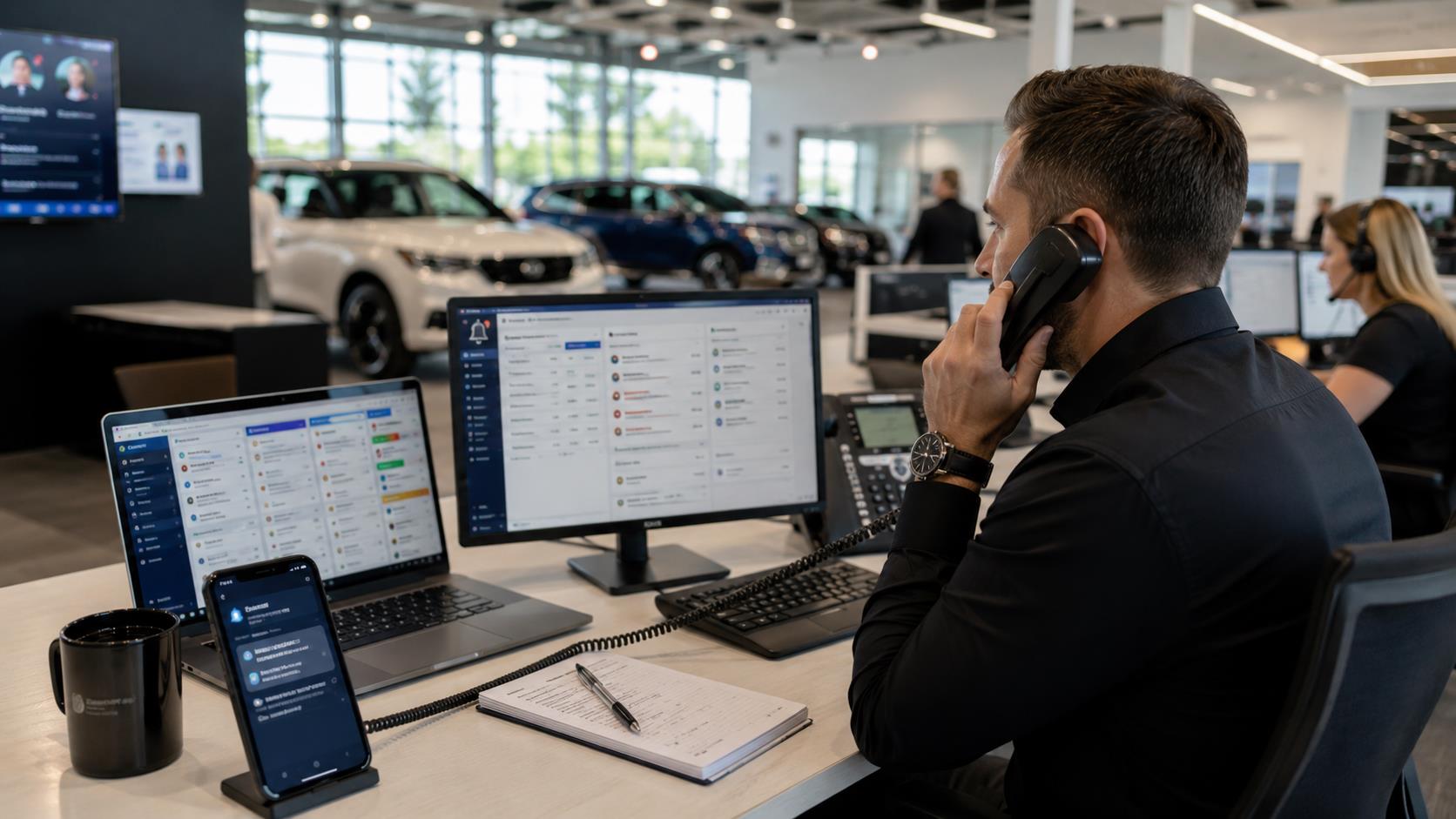
Hitting a 5-minute auto lead response time consistently is a process problem, not an effort problem — no rep can manually catch every lead inside five minutes while also working the floor. Dealerships that sustain elite speed build it into their system. The components that actually move the number are:
- Instant routing. Leads hit the right rep’s phone the second they land — no inbox queue, no manual assignment delay.
- Automated first-touch SMS. A text fires immediately to acknowledge the buyer and hold their attention while a rep gets free to call.
- A staffed BDC window. Someone is accountable for response during every hour leads actually arrive — including evenings and weekends, when most car shopping happens.
- A defined cadence. A documented follow-up sequence so leads not reached on attempt one aren’t quietly abandoned.
- CRM-integrated delivery. Leads flow straight into the system reps already use, so speed doesn’t depend on someone copying details by hand.
This is where lead delivery method becomes decisive. The Autocarleads model pairs real-time delivery with automated SMS so the first touch is already handled before a human is involved — closing the gap that sinks most BDC response time. Dealers can see how live transfers and real-time lead delivery improve close rates by removing the slowest link in the chain: the wait.
How to Measure and Improve Your Dealership’s Response Time
You can’t improve a response time you don’t measure — and most dealerships measure it wrong by tracking when a rep logged contact rather than when contact actually happened. Start by pulling honest timestamps from your CRM: lead submission time versus first genuine attempt, not the note written an hour later.
From there, the metrics worth watching are median response time (averages hide your slow tail), percentage of leads contacted under 5 minutes, after-hours response rate, and the connection rate gap between fast and slow responses. Track those for a month and the leak usually announces itself — typically evenings, weekends, or shift handoffs. The fix is rarely “try harder”; it’s automation and accountability covering the hours nobody was watching. Lead quality compounds the effect too, which is why how pre-screening and income verification work matters: fast contact on a verified buyer converts far better than fast contact on a tire-kicker.
Frequently Asked Questions
What is a good auto lead response time for car dealerships?
A good auto lead response time is under 5 minutes from lead submission to first genuine contact. Five to 30 minutes is acceptable but already loses contact rate, and anything past an hour functions as a cold lead. The five-minute window is the benchmark because the buyer is still actively engaged with their decision.
How fast should a dealership respond to an online car lead?
A dealership should respond to an online car lead within 5 minutes, ideally with a live call backed by an immediate text. Speed matters most because online shoppers typically submit multiple inquiries at once and tend to commit to the first dealer who responds with a real answer.
Why does lead response time affect conversion rates?
Lead response time affects conversion because a lead’s value decays from the moment it’s submitted — buyer attention and intent fade by the minute. Faster contact catches the customer while the decision is live and signals a responsive, trustworthy dealership, both of which lift the odds of a deal.
What is the average dealership lead response time in Canada?
Industry studies of dealership lead follow-up consistently find average response times measured in hours rather than minutes, with many online leads never receiving a meaningful response at all. That gap is precisely why Canadian dealers who respond inside the 5-minute window gain such a large edge over slower competitors.
Does response time matter more for subprime auto leads?
Yes, response time matters most on subprime and bad-credit auto leads because credit-anxious buyers usually apply with several dealers and lenders at once and commit to whoever first gives them a reassuring answer. Fast, calm contact on a credit-challenged buyer converts especially well.
How can dealerships improve their lead response time?
Dealerships improve lead response time by building speed into the system rather than relying on effort: instant routing to a rep’s phone, automated first-touch SMS, a staffed BDC window covering evenings and weekends, a documented follow-up cadence, and CRM-integrated delivery. Automation closes the gap no manual process can.
Win the 5-Minute Window on Every Lead
Autocarleads connects Canadian dealerships with exclusive, pre-screened car loan leads — including subprime buyers — delivered in real time with AI-powered SMS follow-up. Every applicant is income-verified before they reach your team.
- ✅ 100% exclusive leads — never shared
- ✅ Lead buyback guarantee
- ✅ No long-term contracts
- ✅ Geo-targeted to your territory
📍 Address: Serving dealerships across all Canadian provinces
📞 Phone: +1-888-510-0264
🌐 Website: Schedule your free consultation at autocarleads.ca
Selling cars is hard enough. Let Autocarleads bring the buyers to you.